C.L.L.I.F.F. Notes
Constant Love and Learning In Fast Focus — for when time feels tight
- Success this year was bigger than any spreadsheet captured
- Stress has to move through your body, not just your mind
- Your calm is the most powerful classroom tool you have
- It's the baby steps you take to recharge that will keep you strong
- Done is better than perfect, and sleep is non-negotiable
- A clear no right now is an act of love
- Next year gets to look completely different... and there's support for that
How to Finish the School Year Strong Without Burning Out
by Katie Raher, PhD
Y’all… we made it to the final stretch of the school year!
And I also know that “making it” right now might look a lot like surviving. Like shoveling food into your mouth between meetings. Like skipping the bathroom because when is there actually time?! I have been there. More years than I’d like to admit, I ended the school year completely frazzled, holding on by a thread, and calling it dedication. It took me a long time to realize there is a real difference between dedication and depletion. Both will get you to June. Only one gets you there with anything left.
So this post is not about adding one more thing to your plate. It is about a few small, real practices that will help you actually finish strong… and feel something other than relief that it’s over.
What Success Really Looks Like Right Now
Here is the thing nobody says out loud enough this time of year… test scores are not the whole story of what you built.
As a School Psych, I’m a data geek. AND the data misses so much. It doesn’t capture the kid who finally raised their hand in March after months of silence. It doesn’t measure the relationship you quietly rebuilt with the student who came in sideways every Monday. It doesn’t count the laughter on a random Tuesday that nobody planned and everybody needed.
Now don’t get me wrong. Outcomes matter deeply. And here’s what the science also tells us: when we support our own nervous systems and our students’ sense of safety, academic outcomes genuinely improve too. Regulation comes before learning. Always. So taking care of yourself isn’t separate from the job. It IS the job.
But also… in my experience working with thousands of educators, nobody got into this field purely to move a proficiency needle. They got in because they wanted kids to grow, to find what lights them up, and to feel loved. That work happened this year. Even when it was hard. Even when you couldn’t see it.
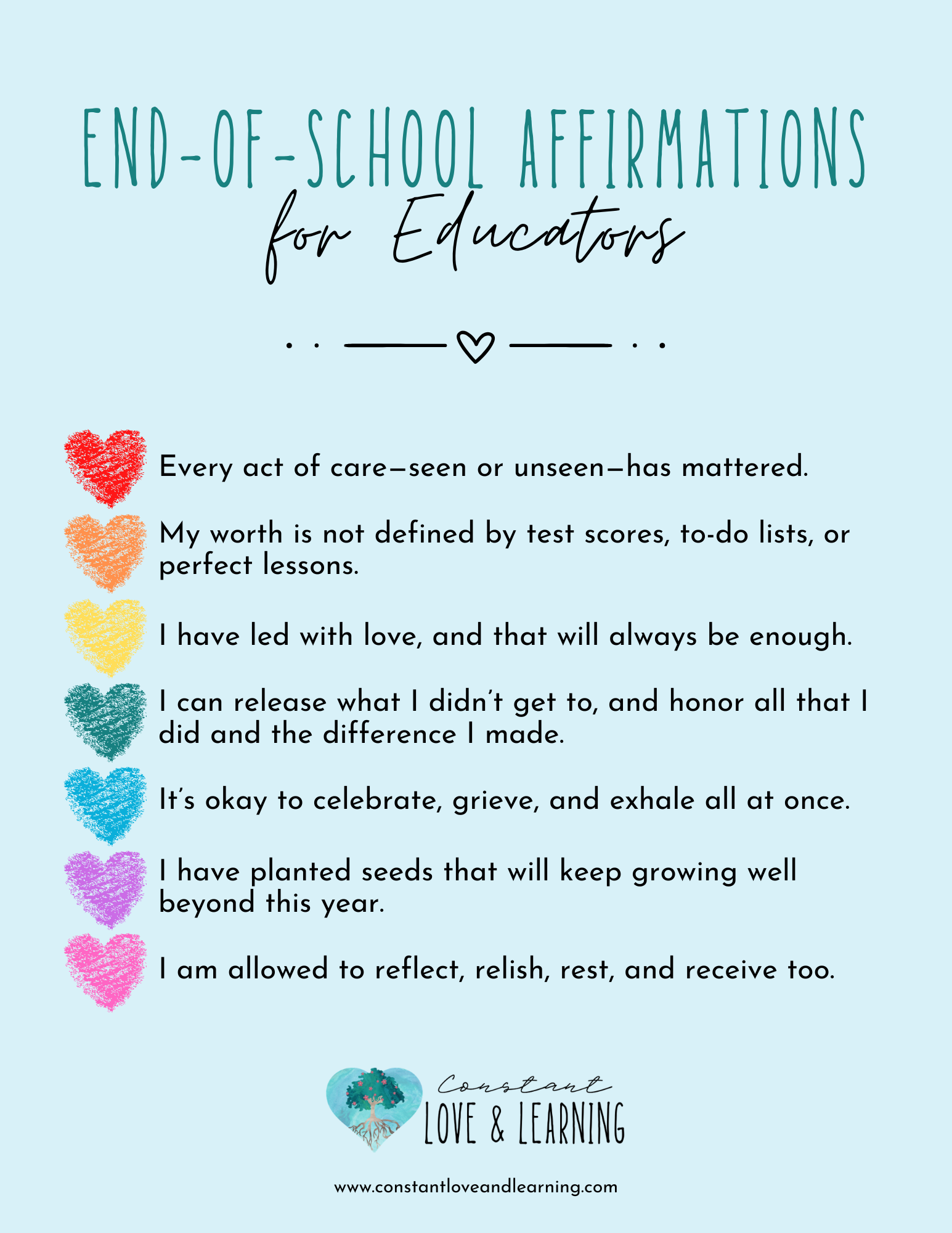
You get to pause and honor all of it. Here are some affirmations to help you lean into this during the home stretch…
A Few Doable Doses That Actually Help
You don't need a retreat or a major overhaul. You need tiny, intentional moments woven into your actual days. Here are some that I come back to again and again.
Start your day with 60 seconds. Before the emails, before the hallway, before the first kid walks in. Three slow breaths. A hand on your heart. One sentence, silently or out loud: I am enough for today. Slow rhythmic breathing activates your parasympathetic nervous system and shifts you out of threat response. And when your students watch you do this alongside them? You're giving them something far more powerful than any lesson plan.
Complete the stress cycle, not just manage it. Researchers Emily and Amelia Nagoski show us that stress is a biological process that has to be completed or it stays stuck in your body. Managing stress and completing stress are not the same thing. A walk, a good cry, genuine laughter, a real human connection... these move it through. Not luxuries. Biological necessities. Are you giving yourself permission to actually complete the cycle, or just white-knuckling through it?
Co-regulate with your students. A 30-second breath before a transition. A movement break you do right alongside them. When you are the regulated adult in the room, you become the thermostat, not the thermometer. You set the temperature. And kids follow a calm, grounded adult in ways no behavior chart has ever replicated. Ever.
Protect your non-negotiable. For me, it is sleep. I protect it fiercely because I know exactly what happens to my capacity, my patience, and my joy when I don't. Yours might be sleep too, or it might be movement, a morning ritual, or time outside. Whatever keeps you steady, treat it as essential. Not optional. Done is better than perfect, and one more email at 11pm will cost you more tomorrow than it gives you tonight.
End each day with glimmers. Write down three moments from today that were real. Not accomplishments. Moments. A connection, a surprise, something that made you smile. And if you don't even have time for that? No problem. Just think about three glimmers on your drive home. That counts. Brené Brown's research on joy tells us that gratitude is the practice that opens us to it. Noticing small good things over time genuinely rewires our nervous systems toward resilience. Brain science, practiced one tiny moment at a time... even from the driver's seat.
Give yourself permission to say No. Before you add one more thing to your plate, ask yourself honestly: will this actually move the needle on the impact I care about most? Or will protected, aligned energy serve my students better than one more well-meaning yes? To help with boundaries with yourself, remember that done is better than perfect. One more email at 11pm will cost you more tomorrow than it gives you tonight. When it comes to boundaries with others, remember that Brené Brown teaches us that clear is kind. Boundaries are not selfishness. They are the strategy that makes everything else sustainable.
What If Next Year Could Feel Completely Different?
If this year felt like too many plates spinning, if you gave your best to school and your scraps to your own people at home, that is not a personal failing. That is what happens when educators are not supported first.
And it doesn't have to be that way next year.
The WholeHEARTed Operating System™ for Schools was built for exactly this. Not another program to stack on top of what's already there. An upstream shift that starts with you, your nervous system, your resilience, and your capacity to lead from a grounded, soul-led place. When educators are genuinely supported first, student transformation follows. The outcomes are measurable. And the experience is finally sustainable.
You planted seeds this year that will keep growing long after this June. You led with love, and that will always be enough.
Your Next Step
If you're ready to explore what a more sustainable, more impactful year could look like for you and your school, I'd love to connect.
Or start right now, today, with our breathwork membership - short, doable, science-backed practices you can begin this week.
Join the Breathwork Membership
Y'all, you made it this far. Let's finish strong, and build something even better together.
FAQs
What does redefining success at the end of the school year actually look like? It means counting what the data missed. The kid who finally raised their hand. The relationship you quietly rebuilt. The laughter on a random Tuesday nobody planned. Test scores matter, and they don't capture the whole story of what you built this year. Both things are true. You get to measure all of it.
Why is the end of the school year so emotionally hard for educators? Because it's cumulative. Months of high demands with not enough nervous system recovery, layered with testing pressure and the weight of measuring an entire year's work against narrow metrics... it compounds in ways that are completely human and completely understandable. It is not a weakness. It is what happens when the system asks educators to keep giving without ensuring they are also being replenished.
How do I avoid burnout in the last few weeks of school? The key is completing your stress cycle, not just managing it. Researchers Emily and Amelia Nagoski show us that stress is a biological process that has to move through your body or it stays stuck there. A walk, genuine laughter, a good cry, a real human connection... these aren't indulgences. They're biological necessities. Pair those with tiny daily practices like a 60-second morning reset and ending your day by noticing three real moments that mattered, and you give your nervous system actual recovery, not just a pause.
How can I help dysregulated students in the final weeks of school? Your own regulated nervous system is your most powerful tool. When you stay calm, slow your voice, and take a visible breath during hard moments, you become the thermostat for your classroom, not the thermometer. You set the temperature. Pair that with short practices your students do right alongside you, like a 30-second breath before transitions, and you shift the room's energy in real time.
How do I know what to say no to right now? Ask yourself honestly: will this thing actually move the needle on the impact I care about most? Or will protected, aligned energy serve my students and my people better than one more yes? As Brené Brown says, clear is kind. A thoughtful no right now is not selfishness. It is the strategy that makes everything else sustainable.
What is the WholeHEARTed Operating System™ for Schools? It is a brain-aligned, heart-centered framework developed by Dr. Katie Raher that integrates MTSS, trauma-responsive practices, UDL, and SEL into one cohesive upstream system. Instead of spinning 17 separate plates, it creates one cohesive heartbeat for your school that starts with educator wellbeing as the primary intervention. When adults are genuinely supported first, student transformation follows naturally and sustainably.
Grab a Free Self-Compassion Poster +
stay connected for Constant Love & Learning news and updates!
We won't ever share your info with anyone, and you can unsubscribe at any time.
Meet The Author